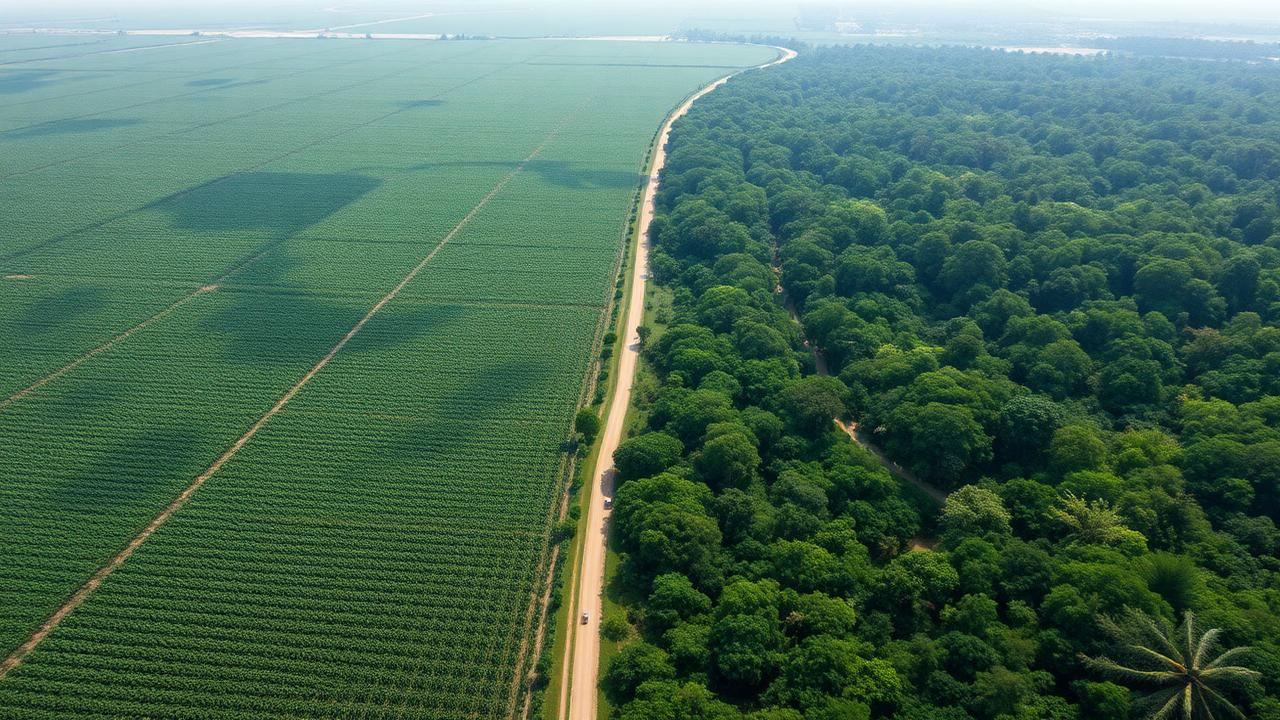
EUDR: the European deforestation regulation and Brazilian agribusiness
A complete guide to the EU Deforestation Regulation: the seven commodities covered, environmental due diligence, geolocation traceability and the impact on Brazilian agricultural exporters.

What the EUDR is (Regulation 2023/1115)
The EUDR is the European Union's regulation against deforestation and forest degradation linked to the consumption and production of certain products. Approved in June 2023, it replaces the EU Timber Regulation, significantly widening its scope in both products and requirements. The core premise is that only deforestation-free products may be placed on the EU market or exported from it. Products cannot have been grown on land cleared after 31 December 2020, nor have contributed to forest degradation. This is not a guideline; it is a law with severe consequences for non-compliance.
The seven commodities covered
The EUDR covers seven primary commodities plus a wide range of their derivatives. The choice was not arbitrary: these were identified as the biggest drivers of global deforestation linked to agricultural production. For Brazil, several of them are strategically undeniable for agribusiness and exports.
- Soy. Brazil is the largest producer and exporter of soy to the European Union. In 2022, Brazilian soy exports (beans and meal) to the EU exceeded US$ 7 billion. The complexity of the soy chain, particularly in the Cerrado, with its many actors and vast cultivated areas, makes compliance a substantial challenge.
- Coffee. Brazilian coffee exports to the EU passed US$ 2 billion in 2022. The Brazilian coffee sector is vast and mostly made up of small and mid-sized growers, which calls for scalable, inclusive traceability solutions.
- Cocoa. Brazil is not the largest cocoa exporter to the EU, but production is significant and growing in some regions. Cocoa concern centres more on countries such as Côte d'Ivoire and Ghana, though Brazil is positioning itself as a potential supplier.
- Beef. Brazil is one of the world's largest beef exporters, with the EU a premium market. In 2022, Brazilian beef exports to the EU reached around US$ 1 billion. The complexity lies in cattle traceability: animals can pass through several farms over their lifetime, demanding a clear view of each animal's origin.
- Timber. The timber sector is not the main focus of Brazil's agricultural exports to the EU, but the volume is still considerable, particularly in processed products. Transparency about the origin of timber, legal or otherwise, is a sensitive point.
- Rubber. Brazil has a history of rubber production, though its share of the EU market is smaller. The rule applies regardless of origin, so Brazilian producers have to meet the requirements to access the European market.
- Palm oil. Palm oil production in Brazil is relatively small, concentrated mainly in Pará and Bahia for domestic consumption and biodiesel. Where there are plans to expand or export to the EU, compliance is mandatory.
Beyond the primary commodities, the regulation covers their derivatives. That includes leather, chocolate, furniture, paper and charcoal, as well as complex products such as biofuels containing palm or soy oil. Including derivatives means that companies exporting manufactured products need full visibility of their supply chain back to the raw material.
The concept of environmental due diligence
At the heart of the EUDR is a requirement for robust environmental due diligence. Declaring a product deforestation-free is not enough; you have to prove it diligently. The process breaks into three fundamental obligations.
- Information collection. The first and broadest stage. Operators have to collect all the information needed to show that products comply with the EUDR. That includes, but is not limited to:
- Name and address of the supplier and buyer.
- Description of the product, including commercial name, type and quantity.
- Country of production and, crucially, the geographic coordinates of every land plot where the products were produced. For cattle, that means the coordinates of every farm where the animal was raised or finished.
- Verification that any clearing predates 31/12/2020 and that production complies with the laws of the country of origin, including human and labour rights.
- Evidence of no forest crime, such as illegal clearing, fire in prohibited areas, or invasion of Indigenous land or protected areas.
*In practice, that means every link in the supply chain, from the farmer to the final exporter, has to be transparent about the origin of its inputs and products.*
- Risk assessment. On the basis of the information collected, operators have to run a systematic risk assessment to identify the likelihood that products are non-compliant. Factors to consider include:
- The presence of deforestation or forest degradation in the production areas.
- The risk level of the country and region of production (a risk classification defined by the EU: high, standard, low). The EU is developing a benchmarking system for this. Regions with a strong deforestation history will certainly be classified as high risk.
- The presence of Indigenous peoples or local communities and the risk of violating their rights.
- The suppliers' compliance history.
- The reliability of the data collected.
*A high risk does not necessarily mean the product cannot be traded, but that the next stage, mitigation, will be more intensive.*
- Risk mitigation. Where the assessment indicates a non-negligible risk, operators have to implement appropriate, proportionate measures to bring it down to a negligible level. That can include:
- Requesting additional information or field analysis.
- Independent audits at farms or processors.
- Supporting and training suppliers to adopt more sustainable, compliant practices.
- Implementing satellite monitoring or other technologies.
- Reviewing and adapting internal control procedures.
*Failing to mitigate detected risks can mean the product is barred from the EU, substantial fines (up to 4% of annual EU turnover) and confiscation of the goods.*
Traceability and geolocation requirements
The backbone of the EUDR is traceability and geolocation. Operators are required to provide the geographic coordinates (latitude and longitude) of every land plot where the commodities were produced.
- Geographic coordinates. Naming the municipality or the farm is not enough. The regulation requires precise geographic points, or polygons delimiting the production areas. For a commodity like soy, that means mapping each field. For beef, the coordinates of every farm the animal passed through from birth to slaughter have to be recorded.
- The cut-off date: 31/12/2020. Any product from land cleared or degraded after that date is illegal for the EU market. Operators will have to check historical satellite imagery of those coordinates to prove there was no post-2020 clearing.
- The tracking systems required. The scale of the task demands robust digital tracking systems. This goes well beyond paper records. Data from different links in the supply chain has to be integrated, from the primary producer to the point of export. Technologies such as blockchain, remote sensing, artificial intelligence and data management platforms become indispensable. Manual data collection across millions of hectares and producers is unviable and error-prone.
Implementation timeline
The EUDR comes into force in phases, but the time available for adaptation is short.
- December 2024 (postponed to 30 December 2025). The compliance deadline for large operators. An operator is any natural or legal person placing covered products on the EU market or exporting from it. That includes multinationals, traders and large agribusiness companies with significant annual turnover or headcount. The one-year postponement to 2025 for large companies may look like relief, but it is in fact a crucial opportunity to accelerate preparation.
- June 2026. The compliance deadline for small and medium-sized enterprises. They have longer, but their capacity to develop and implement due diligence and traceability systems is inherently smaller, which calls for significant support from the value chain, including the large operators that buy from them.
Implementation phase details:
- Transition period. The window between approval (June 2023) and the entry-into-force dates is the time for all operators to develop and implement their due diligence systems.
- Implementing acts and guidance. The European Commission is working on implementing acts detailing the rules for country risk assessment, the formats for due diligence declarations and other technical specifications. Following those publications is vital, because they carry the operational detail.
- Information platform. The EU is to create a platform for operators to submit their due diligence declarations. Interoperability with companies' internal systems will be a differentiator.
- Enforcement and penalties. From the entry-into-force dates, EU member states are responsible for enforcement. Penalties include seizure of products, fines of up to 4% of the company's annual EU turnover and exclusion from public procurement. Brand reputation is also at stake.
Impact on Brazilian agribusiness
Brazil, as one of the world's largest exporters of agricultural commodities, particularly soy and beef to the EU, will feel a significant and multifaceted impact.
- Traceability challenges in the Cerrado and the Amazon.
- Cerrado. This biome, with its dynamic agricultural frontier and a history of clearing for pasture and crop expansion, poses unique challenges. The difficulty of distinguishing legal from illegal clearing, combined with a complex mosaic of rural properties of different sizes, demands a monumental mapping and verification effort. Traceability for soy and beef in the Cerrado will be the real test of Brazilian compliance.
- Amazon. Enforcement is stricter and the pressure for zero deforestation greater, but the geographic scale of the Amazon and the risks of land-tenure irregularity and illegal clearing (often invisible or disguised) create barriers. In the beef chain, cattle movement across multiple farms in the Amazon and adjacent biomes is notoriously complex.
- Cost of compliance. Adapting to the EUDR will not be free. The costs include:
- Technology investment. Acquiring and implementing geomonitoring software, supplier data management platforms and blockchain systems.
- Specialist staff. Hiring or training teams for due diligence, satellite imagery analysis and data management.
- Audits and certification. Costs associated with field audits and any certification needed to evidence compliance.
- Chain engagement. Expenses tied to training and technical support for farmers, especially small and mid-sized ones, so they can supply the required data.
- Loss of market. Companies that fail to adapt risk being shut out of the European market, with substantial financial loss and reputational damage.
- Differentiation and competitive advantage. For Brazilian operators that invest proactively in compliance, the EUDR can become a competitive differentiator. Being a deforestation-free supplier can open new markets and strengthen relationships with European customers who are increasingly demanding on sustainability.
- Pressure on small producers. Without proper support from large traders and meat processors, small and mid-sized producers may find the traceability requirements insurmountable, leading to their exclusion from the EU export chain or, worse, to a grey market of non-compliant products.
How to prepare
Preparing for the EUDR is a continuous, strategic process that demands a holistic and proactive approach.
- Map the supplier chain deeply.
- Go beyond your immediate supplier (Tier 1). Extend the mapping to Tier 2, Tier 3 and all the way to the primary producer. Understand the fragmentation, the risks and the dependencies at each link.
- Identify every aggregation and processing point, because each one has to preserve traceability of origin.
- Implement robust geolocation and monitoring systems.
- Adopt or build platforms that collect and store the geographic coordinates of every production plot. The requirements are detailed on the EUDR page.
- Integrate remote sensing (satellite imagery) to monitor land use in production areas and verify there was no clearing after 31/12/2020.
- Set up mechanisms to record cattle movement between farms, so every property the animal passed through is mapped.
- Document the entire due diligence process.
- Create a clear, auditable system recording each stage: data collection, risk assessment and mitigation measures.
- Keep all documents and evidence organised for presentation to European authorities in the event of an audit. Transparency in the documentation matters as much as compliance itself.
- Engage and train suppliers (Tier 1 and Tier 2).
- This is one of the most critical points. Your compliance depends on your suppliers' ability to provide the required data.
- Develop training programmes for farmers on the EUDR requirements, the importance of geolocation and best agricultural practice.
- Consider offering tools or technical support so producers can collect and send the necessary information effectively.
- Put in place contracts reflecting the new EUDR compliance requirements, with traceability and shared responsibility clauses. See how we structure value chain engagement.
- Assess and manage risk continuously.
- Because deforestation and environmental information are dynamic, risk assessment is not a one-off event but a continuous process.
- Use real-time data and predictive analysis to identify and manage high-risk areas proactively.
- Sector collaboration. Take part in sector forums and initiatives to align protocols and technologies, cutting costs and fragmentation of effort.
How Mangue Tech helps
Mangue Tech delivers three fronts for companies in EUDR scope: a supply chain traceability platform, environmental due diligence consulting, and auditable reports ready for the European Commission.
- Value chain engagement. We develop and implement strategies and platforms to engage your suppliers effectively, from Tier 1 to the primary producer. That includes simplified data collection tools, training programmes and two-way communication systems that encourage participation. Our focus is turning compliance into shared value, so your whole supply chain is aligned and equipped to meet EUDR requirements. See supply chain engagement.
- Supply chain emissions traceability. The EUDR is focused on deforestation, but being able to trace the geographic origin of your products is also fundamental to calculating and managing your Scope 3 greenhouse gas emissions. Our supply chain emissions traceability solutions are integrated, so you can comply with the EUDR while also advancing your decarbonisation targets and answering the sustainability regulations still to come. See the agribusiness view.
- Environmental compliance support. We offer a complete environmental due diligence solution. Our tools combine geomonitoring, satellite data analysis and integration of environmental licensing and government database information to verify that your production areas comply with the 31/12/2020 cut-off and other environmental law. We help automate information collection and produce auditable due diligence reports, giving you the evidence the European market requires. Our framework lets you visualise, monitor and manage deforestation risk across your whole value chain. See the EUDR page.
The EUDR is more than a regulatory obstacle. Companies that adapt early keep access to the European market and end up with a more transparent value chain. Mangue Tech supports that adaptation.
- Map your supplier chain all the way to the primary producer (Tier 1, 2, 3)
- Implement geolocation and satellite monitoring systems
- Document the entire due diligence process in an auditable way
- Engage and train suppliers, particularly small producers
Perguntas frequentes
When does the EUDR come into force?+
For large operators, from December 2025. For SMEs, June 2026.
What is the cut-off date?+
31 December 2020. Products from land cleared after that date cannot enter the EU.
What are the penalties?+
Fines of up to 4% of annual EU turnover, seizure of products and exclusion from public procurement.
- EUDR
- EU Deforestation Regulation (Regulation 2023/1115), the European rule against deforestation
- Due diligence
- The process of investigating and verifying environmental compliance across the supply chain
- Geolocation
- Recording precise geographic coordinates of production plots
- Tier 1/2/3
- Supplier levels in the supply chain, from the direct supplier to the most remote
- Regulamento (UE) 2023/1115 relativo à disponibilização de produtos associados à desflorestação · Jornal Oficial da União Europeia
Frameworks mencionados neste artigo
IFRS S1 & S2 Roadmap
The 12 decisions your CFO has to make before 2027. Free.