

ISO 20121: sustainability management for events
A management system for sustainable events. From planning to legacy. Covers suppliers, transport, lodging, catering, waste and governance.
How to certify an event under ISO 20121
To certify an event or an organizer under ISO 20121, you implement a sustainability management system that meets the standard's requirements, run at least one event with records and pass an audit by an accredited certification body. Mangue Tech structures the system and prepares the documentation; the certificate is issued by the third-party body.
Scope.
Define what will be certified: the whole organization, a line of events or a single event, with the venues and activities included.
Gap assessment.
Compare current management with the ISO 20121 requirements (context, leadership, planning, support, operation, evaluation and improvement) and list what is missing.
Policy and sustainability issues.
Publish the sustainable development policy and identify the relevant environmental, social and economic issues and the stakeholders.
Planning and suppliers.
Set objectives, indicators and owners, and take the criteria down the chain: venue, transport, catering, accommodation and set-up.
Operation with records.
Run the event as planned and keep the evidence: energy, waste, travel, purchases and stakeholder communication. The event's GHG Inventory belongs here.
Internal audit and management review.
Evaluate performance, handle nonconformities and record lessons learned and legacy.
Certification audit.
The accredited body audits the system, usually in two stages (documentation and implementation), issues the certificate and keeps it with periodic audits.
Who runs it
Mangue Tech runs the maturity assessment, structures the management system with owners and indicators, engages suppliers, calculates the event's GHG Inventory and organizes the documentation for the audit. The certificate is issued by an accredited certification body such as SGS or Bureau Veritas.
Companies that trust Mangue Tech







Consulting + Platform
Operational data becomes auditable ESG indicators.
Specialist consulting that understands ISO 20121. A platform that automates the calculation, versions the data and exports it in the format the regulator requires.
Consultoria
ESG data and compliance management, with a specialist who knows your sector.
Plataforma
Our own software, automating calculations, indicators and exports.
Auditable reports
GHG inventory, decarbonization plan and reports ready for the auditor.
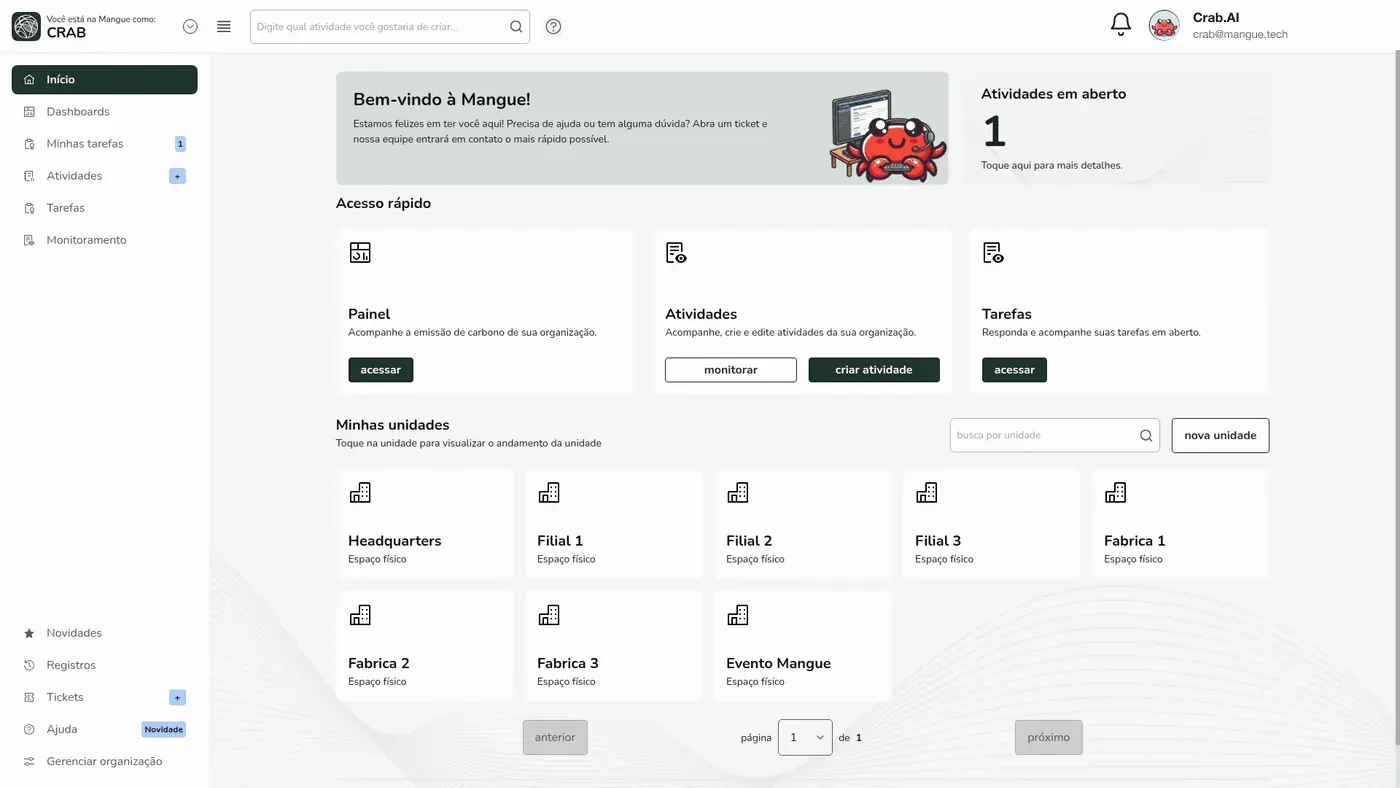
Less time
Automated collection vs. manual spreadsheet.
Global frameworks
IFRS, CSRD, CBAM, GRI, SASB, GHG, CDP…
Emission factors
IPCC, DEFRA, MCTI, EPA, Ecoinvent.
How Mangue works
4 steps. From diagnosis to an auditable report.
Diagnosis
Find out which ESG risks affect your business and what the regulator will require.
Estrutura
Organized data, defined processes and everything ready for any verification.
Operation
Emission calculations, decarbonization targets and continuous monitoring.
Auditable reports
Active compliance with IFRS, CSRD, CBAM, GRI, SASB and GHG Protocol.
Mangue deliverables for ISO 20121
Every delivery is a complete package: consultant + platform + auditable report. Click to see how we apply it.
Frameworks we apply
The framework
What it is, and why it matters.
ISO 20121 is the international standard for a sustainability management system applied to events. It was originally developed for the London 2012 Olympic Games and is now the global reference for large corporate, sporting, cultural and government events.
Unlike a carbon certification, 20121 covers the management system: planning, sustainability policy, stakeholder identification, supplier control, event operation and post-event review. It is about the process, not just the number.
It applies to any kind of event: corporate conferences, industry trade shows, festivals, awards, conventions, sporting events. The scope covers the whole chain: organization, transport, lodging, catering, materials, waste and communication.
The standard follows the PDCA cycle (plan, do, check, act), the same as ISO 9001 and ISO 14001. The organization defines its context and stakeholders, sets a sustainability policy and objectives, controls operations, measures performance and adjusts course for the next event. The view balances environmental, social and economic dimensions.
Stakeholders and legacy are two core concepts. Stakeholders are everyone who affects or is affected by the event: attendees, the local community, suppliers, sponsors, public authorities and workers. Legacy is what remains after the event ends: infrastructure, training for local suppliers, changed practices and data for the next edition.
Three groups use ISO 20121: event organizers and promoters, venues (convention centers, arenas, exhibition halls) and supply chain providers such as stand builders, caterers, agencies and logistics companies. Each can implement the management system within its own scope.
ISO 20121 does not set an emissions limit, but managing environmental impacts calls for indicators. The event's GHG Inventory, covering Scope 1, 2 and 3 (energy, generators, attendee travel, lodging, catering and waste), is the most direct way to measure climate performance within the system. Mangue Tech runs this calculation through its event inventory service.
At scale
When the standard updates, the calculation engine is already up to date.
supported frameworks
GHG Protocol, CSRD, IFRS S2, CDP, GRI, SASB, CBAM, SBCE. One single database.
emission factors
IPCC, DEFRA, MCTI, EPA, Ecoinvent. All versioned, with source, year and gas.
scopes covered
Scopes 1, 2, 3 and biogenic. Operational and financial. Everything goes in.
Applicability
Who it applies to.
- Organizers of large events (over 1,000 attendees) that want objective evidence of sustainable management.
- Sponsors and brands associated with events that need to show ESG criteria in sponsorship contracts.
- Venues, convention centers and operators that want certification as a competitive edge in tenders and contracts.
- Events with international media coverage, where scrutiny over sustainability runs high.
How we deliver
From source to auditor.
Initial maturity assessment against the ISO 20121 requirements: policy, planning, operational control, communication and review.
Setup of the management system with owners, indicators and governance routines. Engagement of the event's suppliers and partners.
Full documentation for third-party audit (SGS, Bureau Veritas or equivalent), with support throughout the certification process.

The IFRS S1 & S2 Roadmap: the 12 decisions your CFO must make before 2027
A practical guide for CFOs, IR Directors, Controllers and Accounting. ~15 min read, straight to your inbox.
We got your info! Camila will send you the IFRS S1 & S2 Roadmap by email shortly.
Frequently asked questions